In The Splendid and the Vile, Erik Larson turns his meticulous storytelling lens toward one of history’s most pivotal moments: Winston Churchill’s first year as Prime Minister during World War II. Covering the period from May 1940 through May 1941, the book blends political history with intimate personal details, following Churchill, his family, and the citizens of London as they endure relentless bombings during the Blitz. Rather than a traditional battlefield narrative, this is a portrait of leadership, resilience, fear, and ordinary life unfolding beneath extraordinary pressure.
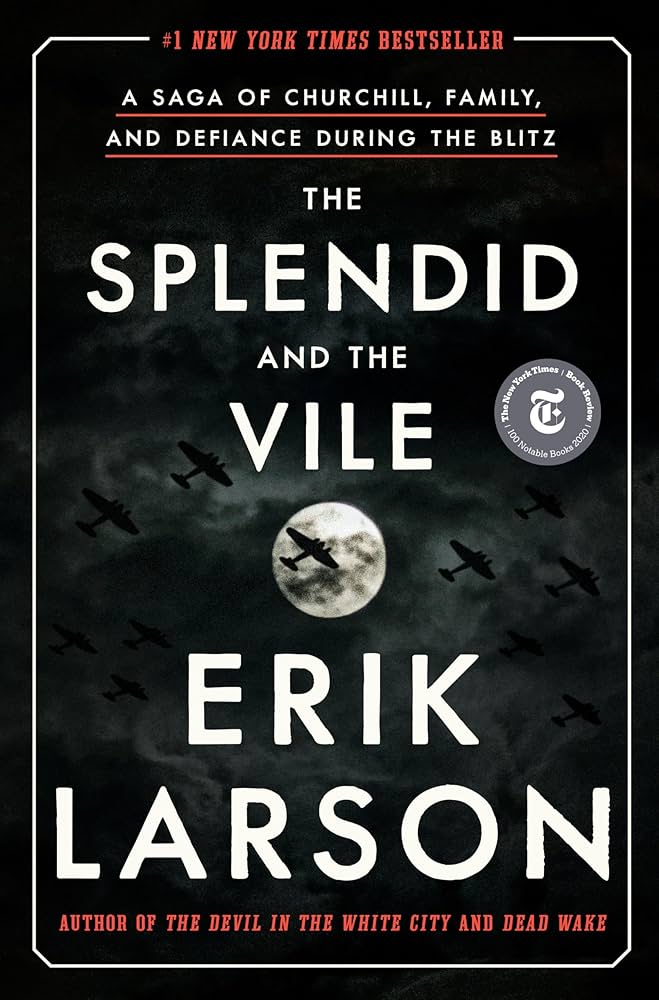
There’s something deeply comforting about returning to Erik Larson’s writing. I’ve always loved the way he transforms history into something immersive and immediate — less like reading a textbook and more like stepping into a living, breathing moment in time. His ability to weave archival research into narrative storytelling remains one of his greatest strengths, and The Splendid and the Vile is another strong example of why his books continue to draw me in.
This time, however, the experience felt slightly different.
Larson trades the propulsive, almost thriller-like pacing of some of his earlier works for a quieter, more observational approach. Instead of building toward a singular dramatic event, the story unfolds day by day, speech by speech, air raid by air raid. The focus rests heavily on atmosphere — the tension humming through London streets, the exhaustion of constant uncertainty, and the emotional toll carried by both leaders and civilians.
At times, that slower pacing made the book feel a bit dry. Sections centered on political logistics or extended social details occasionally dulled the momentum, especially for readers expecting the narrative urgency Larson often delivers. This isn’t a criticism of the research or craftsmanship — both are impeccable — but rather a reflection of the book’s more deliberate rhythm.
And yet, even during those slower stretches, I found myself appreciating the experience.
Larson excels at humanizing history. Winston Churchill emerges not as an untouchable historical figure but as a complicated, driven, and sometimes flawed man balancing immense responsibility with personal vulnerability. The inclusion of diary entries, family dynamics, and glimpses into everyday London life adds texture that makes the era feel startlingly real. The Blitz becomes more than a historical event; it becomes a lived experience filled with anxiety, courage, and stubborn hope.
What stood out most to me was the emotional undercurrent running beneath the historical facts. Larson captures the strange duality of wartime existence — how life continues even as destruction looms overhead. Dinner parties coexist with air raid sirens. Humor survives alongside fear. Humanity persists in the face of relentless uncertainty.
While it may not have the edge-of-your-seat momentum of The Devil in the White City, this book succeeds in a different way. It invites patience. It asks readers to sit inside history rather than race through it.
And honestly, there’s something quietly powerful about that.
The Splendid and the Vile may feel slower and occasionally dense, but it remains an engaging and deeply researched look at a defining moment in modern history. For longtime Larson readers, his signature narrative nonfiction style is still very much present — thoughtful, immersive, and rich with detail — even if the pacing leans more reflective than gripping.
It’s the kind of book that rewards readers willing to linger.
Devour or Nibble?
Nibble leaning toward Devour.
If you love narrative nonfiction, World War II history, or Erik Larson’s storytelling style, this is absolutely worth picking up — just don’t expect nonstop momentum. Best enjoyed slowly, like a carefully prepared meal meant to be savored rather than rushed.
 literary gluttony
Leave a comment