There are some books you read, enjoy, and eventually move on from. And then there are books that seem determined to leave fingerprints all over your soul before quietly closing the door behind them. The Invisible Life of Addie LaRue falls somewhere between the two for me—a beautifully written, deeply atmospheric story that occasionally wandered a little too long, but ultimately delivered an ending that absolutely wrecked me.
In 1714 France, a young woman named Addie LaRue makes a desperate bargain with a mysterious stranger to escape a life she doesn’t want. The price of her freedom, however, is a curse: she will live forever, but no one she meets will ever remember her.
For centuries, Addie wanders through the world, learning how to survive in the spaces between other people’s memories. She leaves her mark in small, fleeting ways while remaining essentially invisible to everyone she encounters.
Then, nearly 300 years after making her bargain, Addie walks into a bookstore in New York City—and someone remembers her.
What follows is a sprawling story about memory, identity, freedom, loneliness, art, love, and the strange ways a person can leave an imprint on the world even when no one remembers their name.
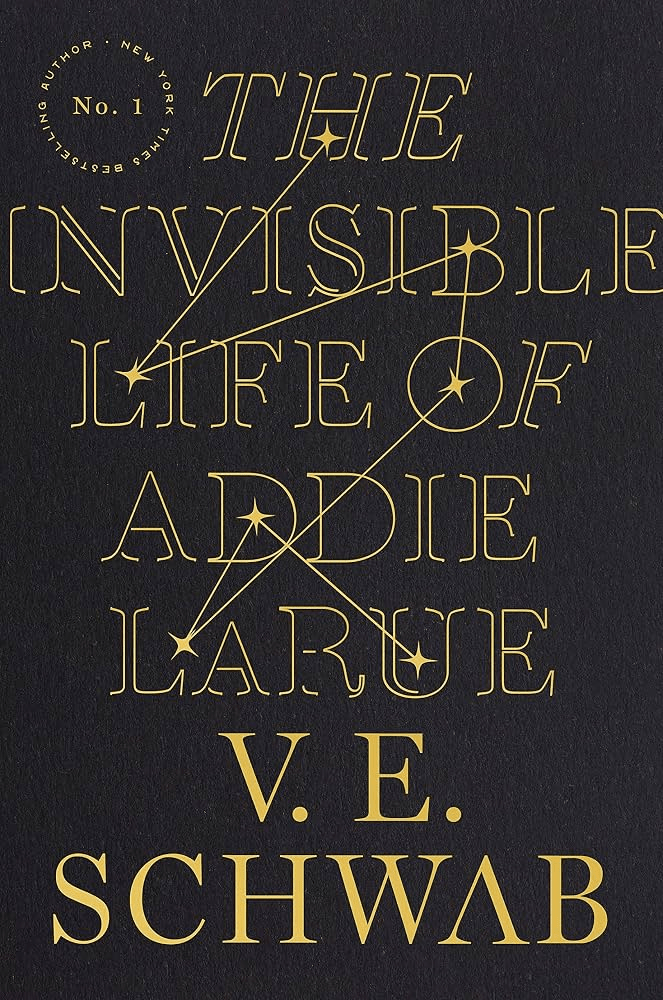
I really, really enjoyed this book.
And I think the biggest reason is that The Invisible Life of Addie LaRue feels like a story about being remembered as much as it is a story about immortality.
The premise immediately hooked me. A woman who cannot die but cannot be remembered? That’s the kind of beautifully cruel concept that practically begs you to ask questions. What does a life mean if no one remembers that you lived it? How do you build relationships when every connection disappears the moment you walk away? What pieces of yourself can survive when you are constantly erased from other people’s lives?
Schwab takes that concept and turns it into something wonderfully atmospheric.
The writing is undeniably beautiful. There are passages that feel almost dreamlike, and the book has this lingering, melancholic quality that made it incredibly easy to sink into. There is something romantic about the way Addie’s existence is woven through history—art, music, cities, people, little moments that she experiences but can never truly share with anyone.
And yet, I did have one fairly significant issue with the pacing.
This book drags in places.
Not catastrophically. Not enough to ruin my enjoyment. But there were definitely stretches where I found myself thinking, Okay, we understand this now. Can we move along?
The story jumps between Addie’s past and her present, gradually filling in the pieces of her life and her bargain. While I generally liked that structure, some of those sections felt repetitive rather than revelatory. The book spends a lot of time circling around the same emotional ideas—loneliness, being forgotten, wanting to be remembered—and while those themes are important to Addie’s story, I occasionally felt like Schwab was telling me something she had already successfully shown me.
Which brings me to another small criticism: the writing can be repetitive.
It’s beautiful repetition, admittedly. Schwab has a knack for a sentence that makes you want to underline it and stare at it for a while. But sometimes that same lyrical quality worked against the story because certain ideas, descriptions, or emotional beats were revisited enough times that their impact started to diminish.
Still, when the writing works, it really works.
There is a particular kind of loneliness woven through Addie’s story that I found genuinely heartbreaking. Not the dramatic, cinematic kind of loneliness, but the quieter sort—the loneliness of having experiences that cannot be shared, of loving things that cannot love you back, of knowing people who will forget you before the day is over.
And then there’s the question of what it means to leave something behind.
Addie can’t leave her name.
She can’t leave a conventional legacy.
But she finds other ways to exist.
That idea stayed with me.
And then there is the ending.
Oh. My. God.
I was not prepared.
I went into the final stretch expecting to be emotional. I did not expect to be sitting there ugly crying like V.E. Schwab had personally reached into my chest, grabbed my heart, and started wringing it out like a wet dishcloth.
The ending absolutely destroyed me.
And what makes it worse is that, in retrospect, it feels so incredibly fitting for the story Schwab had been telling all along. The book spends hundreds of pages asking what it means to be remembered, what makes a life meaningful, and whether a person has to be permanently known to have mattered.
Then it comes along and punches you directly in the feelings.
Rude.
Beautiful.
Devastating.
I think The Invisible Life of Addie LaRue is one of those books where my rating doesn’t quite communicate how much I felt while reading it. It isn’t a flawless book. The pacing could have been tighter, and I think the repetition occasionally dulled the otherwise gorgeous prose.
But I cared about these characters.
I cared about Addie.
I cared about the questions the story was asking.
And by the time I reached the end, I cared enough that the book managed to absolutely emotionally obliterate me.
So, yeah.
3.75 stars.
Not perfect, but memorable.
And perhaps that’s exactly the point.
Devour or Nibble?
🍽️ DEVOUR.
If you love atmospheric, lyrical stories with a touch of fantasy, complicated bargains, bittersweet romance, and existential questions served alongside your emotional damage, The Invisible Life of Addie LaRue is absolutely worth picking up.
Just be prepared to occasionally wonder when the book is going to get to the point—and then be prepared to have that complaint completely forgotten when the ending comes along and rips your heart clean out of your chest.


Leave a Reply