What happens when a country decides that being “cool” isn’t just a happy accident, but something that can be deliberately created?
In The Birth of Korean Cool, Euny Hong takes readers on a fascinating journey through South Korea’s transformation from a war-torn, developing nation into a global powerhouse in technology, business, entertainment, and pop culture. From the country’s economic development and notoriously intense education system to K-pop, television dramas, technology, and the rise of the Korean Wave, Hong explores the many pieces that helped shape modern South Korea.
Part cultural history, part memoir, and part investigative journalism, the book looks at Korea from both an insider and outsider perspective. Hong grew up partly in South Korea after moving there from the United States as a child, giving her a particularly interesting lens through which to examine the country and its rapid transformation.
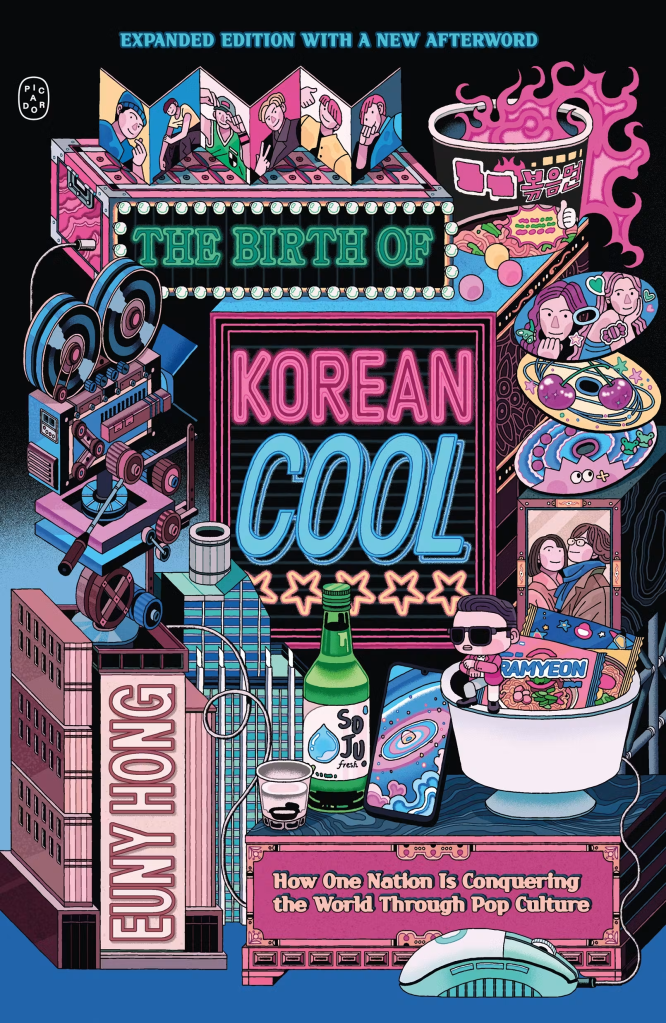
I’ve always found it fascinating how a country’s culture can suddenly seem to be everywhere. Korean dramas, K-pop, Korean food, skincare, technology—you don’t have to look very far these days to find some piece of Korean culture making its way into the rest of the world.
So naturally, The Birth of Korean Cool caught my attention.
And I really enjoyed learning more about Korea through this book.
One of my favorite aspects was getting to see just how much history, strategy, government investment, cultural expectations, and sheer determination went into creating the Korea that many of us recognize today. The book makes it clear that the worldwide popularity of Korean culture didn’t simply happen overnight. There was an enormous amount of work, planning, and cultural change behind it.
I also really enjoyed Euny Hong’s voice.
There’s a wit and irreverence to her writing that kept the book from feeling like a straightforward history lesson. She isn’t afraid to poke fun at Korea, herself, or some of the stranger contradictions she encounters along the way. That perspective—being familiar enough with the culture to understand it while also being far enough outside it to question it—made for some particularly entertaining observations.
And honestly, I think that voice is what kept me engaged during some of the portions that didn’t grab me quite as much.
Because while there was a lot here that I found interesting, I did struggle with some sections that felt a little dry. There were moments when I found myself reading more because I wanted to finish the chapter than because I was completely absorbed in what I was reading.
That said, I’m not entirely convinced the problem was the book.
Sometimes you pick up a book at exactly the wrong moment for what it’s offering. And I suspect some of my difficulty with the drier sections had as much to do with my own mindset while reading as it did with Hong’s writing. There was plenty of information I genuinely wanted to absorb, but I wasn’t always in the mood to sit with the more analytical or historical portions.
Which is a shame, because some of those sections contain the most interesting pieces of the book.
I especially appreciated how The Birth of Korean Cool challenged the idea that Korea’s rise to global prominence was simply the result of technological advancement or the popularity of K-pop. Hong digs into the larger cultural machinery behind that success and examines how entertainment, economics, education, government, national identity, and even historical resentment all became intertwined.
It gave me a much broader understanding of Korea than I would have gotten from simply consuming its pop culture.
And I think that’s ultimately what I’ll remember most about this book.
It made me curious.
Curious about Korean history. Curious about the culture. Curious about the forces that shaped the country into what it is today. And, perhaps most importantly, curious about all the things I don’t know yet.
Would I have preferred a slightly faster pace in places? Absolutely.
Did every chapter hold my attention equally? Definitely not.
But did I come away feeling like I’d learned something worthwhile while also getting to spend time inside a distinctive, occasionally hilarious, occasionally biting perspective on Korea?
Absolutely.
The Birth of Korean Cool isn’t necessarily a book I’d describe as an effortless read, but it is an interesting one. And sometimes a book doesn’t have to completely sweep you off your feet to make you want to keep exploring the world it introduced you to.
Devour or Nibble?
Nibble. 🍜
This is one for readers who enjoy cultural history, memoir, journalism, and getting a behind-the-scenes look at how a country became a global cultural force. There were a few dry stretches that slowed me down, but Hong’s sharp voice and the fascinating subject matter kept me coming back to the table.
I didn’t devour every page—but I definitely left the table hungry to learn more about Korea.


Leave a Reply